
Academics
Read closely. Make a case. Solve a problem. Ask what happens next.
Across grades 6–8, you build strong foundations in English, mathematics, science, history, and civics. Earth, Life, and Physical Science offer different ways to investigate the world. Language study, computer science, art, wellness, and leadership broaden the experience.
You also learn how to learn: how to organize your work, test an idea, explain your thinking, and consider someone else’s perspective.
Woodward’s Middle School English curriculum supports student learning as they discover the world and grow as individuals. The English Department seeks to encourage competent and compassionate learners who engage with multiple literacies, recognize, and synthesize multiple viewpoints, and present reasoned conclusions in a variety of media. Students will read literary selections that offer windows, mirrors, and sliding doors, inviting them to consider the complexity of their lives and the lives of others. Middle School students build foundational skills through close-reading and discussion of formative texts, both fiction and non-fiction. Students are required to complete extensive independent reading throughout the year. Students develop writing and editing skills through a variety of writing assignments, journaling, and creative projects.
- MS English I: How Do Stories Shape Identity?
- MS English II: How Do Perspectives Shape Stories?
- MS English III: Who Controls the Story?
Woodward’s Middle School History Department endeavors to teach students about the events, institutions, people, and social and cultural experiences of humanity throughout history. Students are encouraged to see and interpret the world beyond them through a growing rigor in reading, writing, thinking, research and presentation. The History Department emphasizes analyzing primary and secondary documents, debating and comparing viewpoints, understanding bias, geography skills and connecting history to the present.
- World Geography & Ancient Civilizations - Latin America/Middle East
- World Geography & Ancient Civilizations - Asia/Europe
- American History & Civics
The Middle School Latin curriculum presents students with essential knowledge and skills that will serve them
throughout the rest of their education and lives. All Woodward students study Latin in grades 7 and 8. Students
gain a solid understanding of the syntax, vocabulary, and grammar of the Latin language. Using this knowledge, they will be able to translate progressively more challenging texts, and ultimately encounter original Latin authors in their native language. Students improve their concept of language and communication through a broad, comparative understanding of how languages work. While building key study habits such as memorization, and building a consistent study schedule, they engage in an in-depth inquiry into the culture, religion, and history of the classical world.
- Middle School Latin I
- Middle School Latin II
- Middle School Latin III
The Middle School Mathematics program emphasizes problem-solving and helping students to think strategically when solving a math problem. Students learn through hands-on activities and scaffolded instruction. Throughout the middle school years, students investigate and perform operations with integers, fractions, decimals, and percentages. The curriculum also focuses on the study of geometry and probability and statistics. In the classroom, students make connections between these topics and real-world situations.
- Math Foundations
- Pre-Algebra
- Algebra I
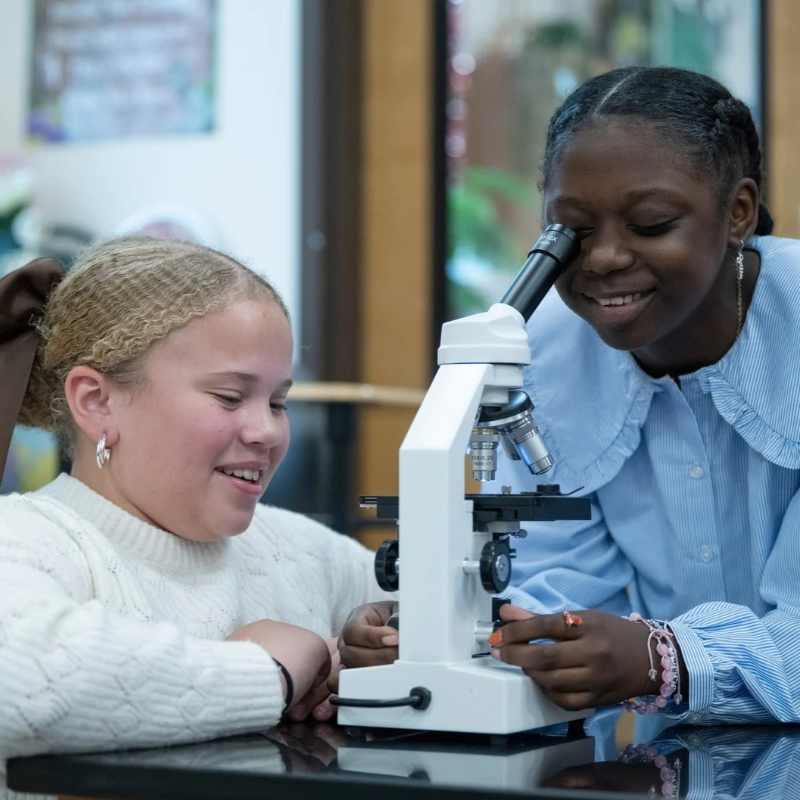
The Science Department guides students to see the world from an observer's perspective, using scientific inquiry methods to analyze information and apply it to decisions they will make about their immediate and global communities. Through hands-on learning, students develop the scientific skills needed for success in high school science courses, as well as critical thinking skills they will use throughout their lives. Participation in the Science Fair is required each year, for all students.
- Earth Science
- Life Science
- Physical Science
This dynamic, cross-curricular seminar is designed to empower sixth-grade students with the essential academic and life skills they need to thrive in middle school and beyond. Through engaging, project-based learning, students will strengthen their reading and writing abilities, solidify their understanding of math concepts, and build confidence in research and study strategies. Students will explore how core academic skills connect and apply to various disciplines, while learning how to communicate effectively, work as a team, and take ownership of their learning.
Students will gain knowledge, understanding, and skills in computing and technology through computer usage,
coding and programming. A core objective of the program is to guide students in learning to articulate and define problems clearly and precisely, and to understand a research-based process to select the best technology devices, tools, and solutions to those problems. Each year students further develop their computational thinking and problem-solving skills, using technology as the facilitator.
- Computer Science Foundations
This class engages Middle School Students in solving various challenges using the Engineering Design Process — encouraging communication, creativity, and collaboration. The class utilizes the Woodward School Maker Space, where students can design, create, and imagine new solutions to problems with their peers.
The Arts, both Visual and Performing, are core elements of Woodward’s Middle School curriculum. Students study the artwork, music, and dramatic work of those who have gone before, while exploring and developing their own individual creative skills and identities.
- Middle School Art Foundations
- Theater Arts
- Chorus
Taking place at the end of May, IL@W is a service learning immersive experience for all middle school students. Designed in project based lessons through academic lenses, students will be challenged to think about a world beyond the one they have experienced. They will have the opportunity to meet someone who they might not have encountered before and understand how all academic fields can come together to examine an issue.
Woodward’s health curriculum is designed according to the National Health Standards for Middle School and leads students through a developmentally appropriate study of adolescent health and wellbeing.
Leadership Seminar empowers girls in grades 6-12 with leadership skills, confidence, and a deep understanding of diversity, equity, and inclusion (DEI), preparing them to be effective leaders in their communities and beyond. The curriculum is organized into monthly modules focusing on specific leadership themes. Modules include interactive workshops, individual and group activities, reflection exercises, and community engagement projects, all designed with DEI principles at the core.
All Woodward students are required to participate in service to school and community, each year. Woodward believes that the regular practice of service to benefit others is enriching, enlarging, and sustaining to those who participate, and will direct them toward a lifetime of ongoing service and goodwill. Service requirements will be discussed and shared with students and families at the start of the academic year.
UPPER SCHOOL | Grades 9-12 | A small school. Room to think big.
Question an assumption. Defend an interpretation. Design an investigation. Follow an idea further.
Across literature and language, mathematics, history, science, the arts, and computer science, you move beyond knowing the material to deciding what to do with it. You weigh evidence, consider competing perspectives, and develop arguments you can support. Teachers challenge you to sharpen your thinking, revise your work, and take on increasingly complex questions.
Advanced coursework and dual enrollment* with Quincy College offer opportunities to extend your learning. As your interests deepen, you build the knowledge, independence, and judgment to take your next academic step with confidence.
*Dual enrollment availability, eligibility, and placement should be discussed with the school.
Woodward’s Upper School English Curriculum offers a sequenced and comprehensive course of study in literature, composition, reading, grammar, and language. Department courses focus on developing student strategies for understanding, interpreting, and evaluating texts through written and oral expression, and for developing competent and analytical readers and writers. The study of rhetoric is infused into our Upper School Curriculum for grades 9-12. Our focus on rhetorical principles teaches students to write and speak with purpose, develop arguments using logic and reason, and to always consider one’s audience. In addition to the development of critical presentation and public speaking skills, students are taught to recognize the extraordinary power of words and how to use language to effectively communicate ideas in a variety of forms and genres. Placement in an Honors or advanced course requires departmental approval.
- Literature I: Introduction to Writing and Critical Thinking
- Literature II: Developing Writers and Thinkers
- Literature III: Global Perspectives in Literature
- Literature IV: Advanced Expression in Western Literature
- AP English Language & Composition
- AP English Literature & Composition
Woodward’s History and Social Studies Department endeavors to teach students about the events, institutions, people, and social and cultural experiences of humanity throughout history. Students are encouraged to see and interpret the world beyond them through a growing rigor in reading, writing, thinking, research and presentation. The History Department emphasizes knowledge and understanding of geography, nation states, government and political institutions, societies and cultures; and analyzing primary and secondary documents, debating and comparing viewpoints, civic engagement, understanding bias, and connecting history to the present.
- World History I: Creating a Modern Worldview
- World History II: The Age of Nationalism and Globalization
- United States History: Colonization to World War II
- AP United States History
- United States Government and Politics
"When we embark on the study of a language not our own, we are initiating a learning adventure which, over and above the invaluable acquisition of another language, can confer upon us multiple educational benefits, capable of exerting a profound influence on our perceptions of the world around us and of permanently enriching and enlarging our appreciation and understanding of ourselves and of others. Language learning is never just about words. Language is the medium in which human beings think and by which they express what they have thought. The study of language – any language – is therefore the study of everything that pertains to human nature, as humans understand it." American Council of Teachers of Foreign Languages.
The World Language Department closely follows the core concepts and guiding principles of The American Council of Teachers of Foreign Languages. In language acquisition, the focus is on speaking and formal expression, grammatical structure and the reading and appreciation of great works of literature in the original language, with emphasis on understanding cultural context, and addressing national standards of cultural communication, connections, comparisons and communities.
The World Language Department closely follows the core concepts and guiding principles of The American Council of Teachers of Foreign Languages. In language acquisition, the focus is on speaking and formal expression, grammatical structure and the reading and appreciation of great works of literature in the original language, with emphasis on understanding cultural context, and addressing national standards of cultural communication, connections, comparisons and communities.
- Spanish I
- Spanish II
- Spanish III
- Spanish IV
- Spanish V: Advanced Composition and Reading
Through the traditional learning of Latin, students will learn to translate the Roman authors in their original language. They will also develop proficiencies in thinking cogently, writing clearly, and speaking with conviction and impact.
- Latin I
- Latin II
- Latin III
A firm foundation in conceptual mathematics and a facility in problem solving are essential for students to be successful in today’s complex and increasingly technological society. The Upper School mathematics curriculum is designed to provide students with opportunities to develop skills, gain understanding of concepts and processes, and to apply these skills to real world situations. Four years of mathematics is required for graduation. Certain Science or Computer Science classes may be substituted for one math class. The table below indicates possible course progressions through the Upper School Mathematics curriculum.
- Algebra I
- Geometry
- Algebra II
- Precalculus
- Statistics
- Calculus
- Advanced Placement Calculus
Through a general course of study, Upper School students prepare for success in college science and health studies programs. Students learn to view the world through the lens of scientific inquiry methods to analyze information and apply it to decisions that they will make about their immediate and global communities. Four years of science are required for all Upper School students, two of which must be the lab sciences, Biology and Chemistry. Participation in the Science Fair is required for grades 9 and 10.
- Biology
- Chemistry
- Environmental Science
- AP Biology
- Physics
- Marine Ecology
- Anatomy & Physiology
- AP Psychology
Computer Science students engage in the study of four distinct strands:
Upper School students deepen their learning through a series of project-based learning objectives. Students are supported in content creation, videography, programming, 3D Design and more.
- Digital Literacy & Computer Sciences
- Computational Thinking
- Computing & Society
- Digital Tools & Collaboration
Upper School students deepen their learning through a series of project-based learning objectives. Students are supported in content creation, videography, programming, 3D Design and more.
- Python
- Advanced Python
- Advanced Topics in Computer Science
The Visual Arts are a vital part of Woodward’s academic program. Through painting, drawing, design, and mixed media, students build a strong foundation in visual literacy while developing creative confidence and critical thinking. While we nurture potential artists, we also equip all students with tools to see—and interpret—the world through a new lens. Just as science explores the physical world, math sharpens quantitative reasoning, and philosophy deepens our understanding of the inner life, art provides a material language for human expression. In a culture shaped by mass production and digital immediacy, the act of making re-centers the value of the handmade and reminds us of the power of personal vision. Students are encouraged to take creative risks, reflect on their process, and explore diverse cultural perspectives. In doing so, they not only strengthen their artistic voice—they also build empathy, resilience, and a deeper connection to the world around them.
- Studio Art Foundations
- Advanced Studio Art
- Contemporary Art Practice
- Advanced Placement Art & Design
THEATER
At Woodward the theater group historically produces two productions annually. In this class students will explore the fundamentals of theater and work on preparing for and carrying out the school’s theater productions. Within this course students will be given options to perform on stage, create artistic materials for the productions, and/or be part of the technical crew that works on lighting, sound and more.
CHORUS
Students in chorus learn basic theory, piano and voice skills, to support their choral repertoire. Students learn how to read and interpret music on the staff, identify musical notes and rhythms, and improve their pitch accuracy. They will progress to combine their theory and basic piano skills to aid in learning their choral music. Students will perform at some school functions and assemblies.
This course focuses students’ attention on creating for publishing and presentation for The School’s publications: Yearbook and Greenleaf Art & Lit Magazine and public presentation of works for WSG events like Night of the Arts and Theatre Productions.
What happens when you take learning beyond the classroom? Through IMPACT Learning, you spend two weeks exploring a topic, pursuing an interest, or contributing to work in the community. You put ideas into practice and discover how your learning connects to the world around you. In Upper School, you take greater ownership through an immersive learning experience, a supervised independent project, or an internship with a business or nonprofit. You practice managing your time, working with others, and taking responsibility for meaningful work. Students across grades share their projects and reflections at the IMPACT Learning Symposium, explaining what they explored, what challenged them, and what they learned.
As part of the Upper School English Language Arts curriculum, students hone their storytelling, presentation, and public speaking skills in a once weekly Integrated Arts lab program. Our meetings focus students’ attention on the art of rhetoric while expanding their knowledge of core coursework by exploring the stories behind the subject matter. Students explore the art of storytelling through multiple mediums by discovering and applying their artistic talents to collaborative as well as individual cross-disciplinary research-based performance projects.
In this course students learn tools necessary to be successful in real life by covering important topics such as financial literacy, health and nutrition, home and family management, and apparel. Students explore these topics through hands-on projects to learn how to budget, meal plan, manage time, and perform home and clothing repairs. The focus is on developing problem solving skills to make informed decisions in life as they move on to college and beyond.
Woodward’s health curriculum is designed according to the National Health Standards for Upper School and leads students through a developmentally appropriate study of adolescent health and wellbeing.
Leadership Seminar will empower girls in grades 6-12 with leadership skills, confidence, and a deep understanding of diversity, equity, and inclusion (DEI), preparing them to be effective leaders in their communities and beyond. The curriculum is organized into monthly modules focusing on specific leadership themes. Modules include interactive workshops, individual and group activities, reflection exercises, and community engagement projects, all designed with DEI principles at the core.
All Woodward students are required to participate in service to school and community, each year. Woodward believes that the regular practice of service to benefit others is enriching, enlarging and sustaining to those who participate, and will direct them toward a lifetime of ongoing service and goodwill. Service requirements will be discussed and shared with students and families at the start of the academic year.

